Practical karaoke · Connection guide
Karaoke Set for Home: Buy Only the Parts You Need
Updated 25 October 2026. Originally published 18 October 2026. This is a buying decision guide, not a hands-on equipment test. Budget bands below are planning choices, not current quotations or promises about complete-system prices.
Write down four jobs before choosing a box
A home karaoke night needs a song source, readable lyrics, a microphone path and amplified playback. One device can do several jobs, but the packaging does not tell you which jobs your room still lacks. Start with equipment you can name and document, rather than a bundle that merely looks complete.
| Job | Your inventory | Evidence to collect |
|---|---|---|
| Play the song | TV app, phone or another playback device | The app and device you will actually use |
| Show the lyrics | TV, tablet or built-in screen | Readable words from the singing position |
| Bring in your voice | Microphones and their supported receiver or mixer | The documented connection to the next device |
| Make voice and music audible | Compatible amplified speaker or audio system | Its exact model and accepted input |
Mark each row owned and verified, owned but unverified, or missing. Do not count an unverified item as a saving yet. A soundbar you cannot connect may be useful for watching films while still being unsuitable for the karaoke route you are considering.
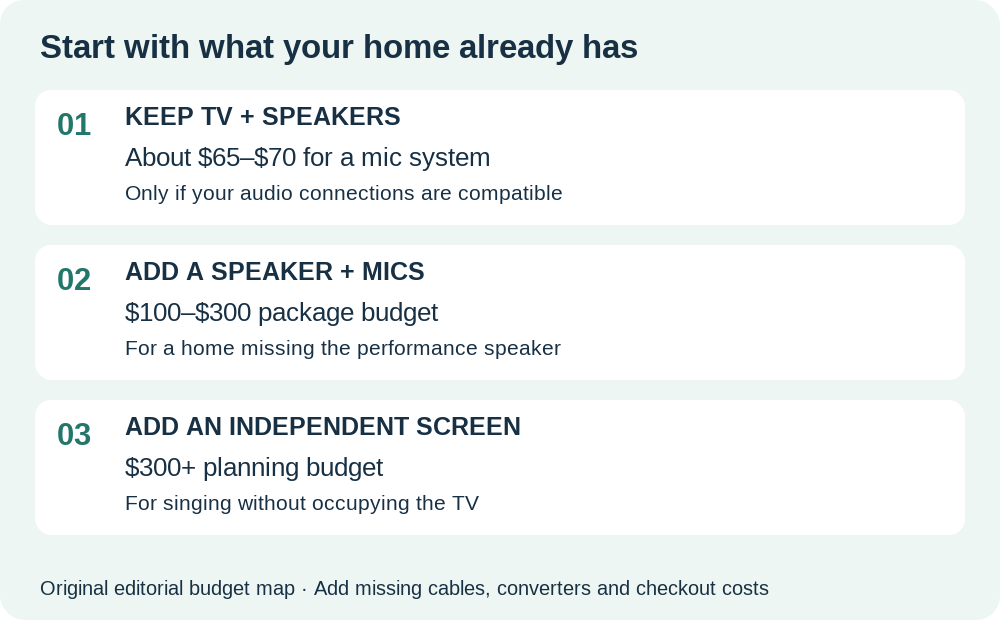
Choose the budget route that fills your missing job
Route 1: reuse the TV and audio equipment
Best for: a room with a usable lyrics display and an audio destination whose input you have verified. Spend on the microphone system and documented connections instead of automatically buying another screen and speaker.
The earlier research snapshot found the FIFINE K036 microphone system at $66.99 on 18 October 2026. That historical figure explains the roughly $65–$70 starting route; it is not a current offer or a complete-room budget. Today, obtain a fresh quote and include every missing speaker, cable and converter before comparing it with a bundle.
Route 2: plan $100–$300 for a speaker-and-mic package
Best for: someone who can already display lyrics but lacks a suitable speaker and microphone arrangement. Use this as a shopping budget to test against actual package contents, rather than assuming every product in the band supplies everything.
Write “lyrics source supplied by me” on the comparison sheet if that is the plan. Ask which microphones, receivers, power supplies and connection cables are included. A package that supplies voice amplification can still leave song playback or the link from your TV unresolved.
Route 3: consider $300+ for an independent screen-equipped setup
Best for: a household that wants karaoke without occupying its TV, or needs a dedicated display in another room. The additional screen should remove a practical constraint; it is not evidence of better sound.
This is a planning band, not a minimum price for every screen-equipped product. Confirm the song-selection workflow, internet requirements and any recurring service charges. For those questions, use our separate screen buying guide. Do not pay for independence until you have identified when you will use it.
Compare the completed route, not the box price
Make two totals: one-time equipment and connection cost, and ongoing song-service cost. Put taxes and delivery into the first total when the seller supplies them. If a line remains unknown, label it unknown rather than silently entering zero.
Your reason to spend more should finish this sentence: “The cheaper route cannot do ___ with the equipment I have verified.” If you cannot fill the blank, investigate the cheaper route before moving up.
One documented example: the TV and microphone mixer have separate jobs
FIFINE’s home-theater instructions, reread for this update, describe feeding TV audio to the K036 input and routing mixed audio onward to compatible amplified equipment. The guide distinguishes analog TV output from optical output that needs conversion. This is a model-specific example, not a universal connection promise.
A cable that fits physically does not establish a complete route. Identify the output and the receiving input in their manuals. See the TV connection guide for directions, and the separate TV buying checklist when comparing equipment. This main page chooses what to buy; it does not replace either detailed check.
Send this exact-equipment question to the seller
Replace the blanks before sending. The purpose is to obtain a checkable answer about your room, rather than a general statement that a product “works with TVs.”
I plan to use [song app] on [playback device and model], show lyrics on [screen and model], and hear voice plus music through [speaker or audio-system model]. I am considering [exact product and variant]. Please identify each supported output-to-input connection, list the included parts, and list every extra cable, converter or powered device I must buy. Please link the manual sections supporting this route and identify any song-service requirements.
Keep the reply with the listing. If the seller answers for a different variant, the question is still open. If a claim has no supporting instructions, ask the manufacturer before ordering the adapter that is supposed to make it work.
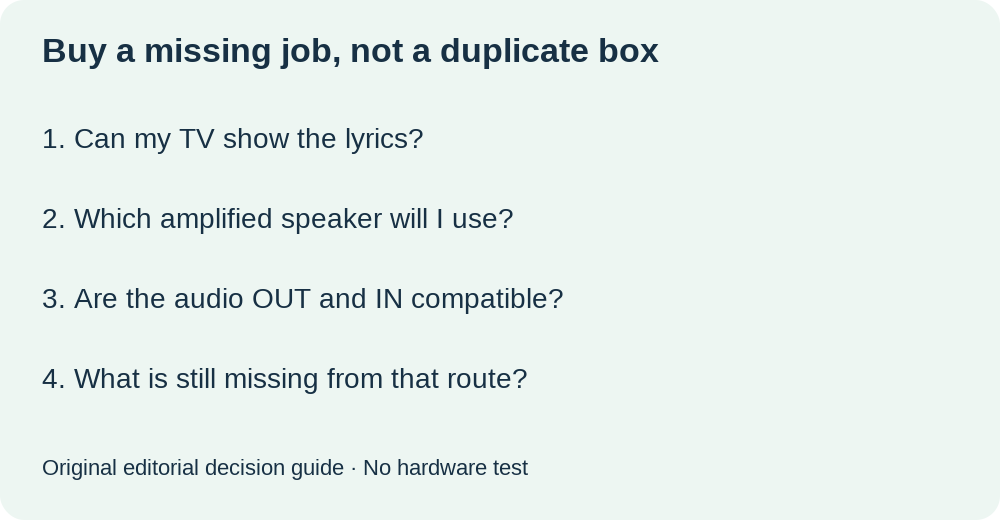
The purchase gate: four answers before checkout
- Inventory: every required job has a named device, or a priced missing item.
- Connections: the exact source output and destination input are supported by documentation.
- Contents: the seller identifies what is included and what you supply separately.
- Cost: your complete equipment total fits your budget, with recurring service costs listed separately.
If all four are answered, compare the practical convenience of the complete routes. If one is unanswered, pause that purchase and resolve the missing evidence. This is a buying gate, not a claim that we have tested the resulting system or can guarantee its performance.
Watch the three budget choices
Original editorial visuals and synthetic English narration. No hardware demonstration or product test.
The video above is the original 18 October budget overview. This 25 October written update adds the inventory, seller request and purchase gate; it does not claim that the existing video has been remade.
Quick answers
What should a karaoke set for home include?
Enough equipment to cover song playback, lyrics, microphone routing and amplified sound. Some of those jobs may already be covered by compatible devices you own, so there is no single mandatory shopping bundle.
Do I need both a mixer and a complete package?
Do not add a separate mixer just because its name appears on a checklist. First establish which device in the chosen route combines the signals you need and whether it accepts the documented connections. Buy another component only for an identified missing job.
Is a built-in screen necessary if I have a TV?
No additional screen is needed merely to duplicate lyrics your existing screen can display. Consider one if independence from that TV matters, then verify the song workflow and total cost.
Original editorial inventory, budget comparison, seller request and purchase gate. Manufacturer connection facts are attributed above. No physical hardware test, live price verification, sound measurement or sales ranking is claimed.